


Competitive Socialising Is Having a Moment. Here's Why It Works
Think back to the last genuinely great night out you had in Manchester. Not a fine one, a great one. The kind where the time disappears and everyone is still talking at the end. There's a reasonable chance something competitive was involved. A game, a leaderboard, a friendly argument about whether that putt was in or not.
Competitive socialising has quietly become one of the better answers to the question of what to actually do in Manchester, and there's real psychology behind why it works.
What competition does to a group
When people play together with a light competitive element, something shifts. Shared experiences under mild pressure form social bonds faster than passive ones. Watching someone react to a challenge (the frustration, the triumph, the immediate protest that the game is rigged) reveals something authentic that a conversation over dinner rarely gets to. There's also something physiological happening: friendly competition triggers a mild adrenaline response, laughter releases endorphins, and you've got a group of people having a better time than they would sitting still.
The key word is friendly. Low-stakes competition, where losing is mostly an excuse for banter, strengthens social bonds rather than fracturing them. The sweet spot is a game where everyone cares just enough.
Why crazy golf hits that sweet spot
Most competitive socialising activities in Manchester are too far in one direction or the other. Pub quizzes require a certain kind of person. Escape rooms can tip into stress. Bowling is great for forty minutes and then something shifts.
Crazy golf has always occupied that middle ground naturally. The turn-taking format means the group is always watching someone, always reacting. The skill ceiling is low enough that a terrible shot is funny rather than embarrassing. Moving through a course together keeps everyone physically close, which matters more than people realise for group cohesion.
What Putters Manchester adds to the equation
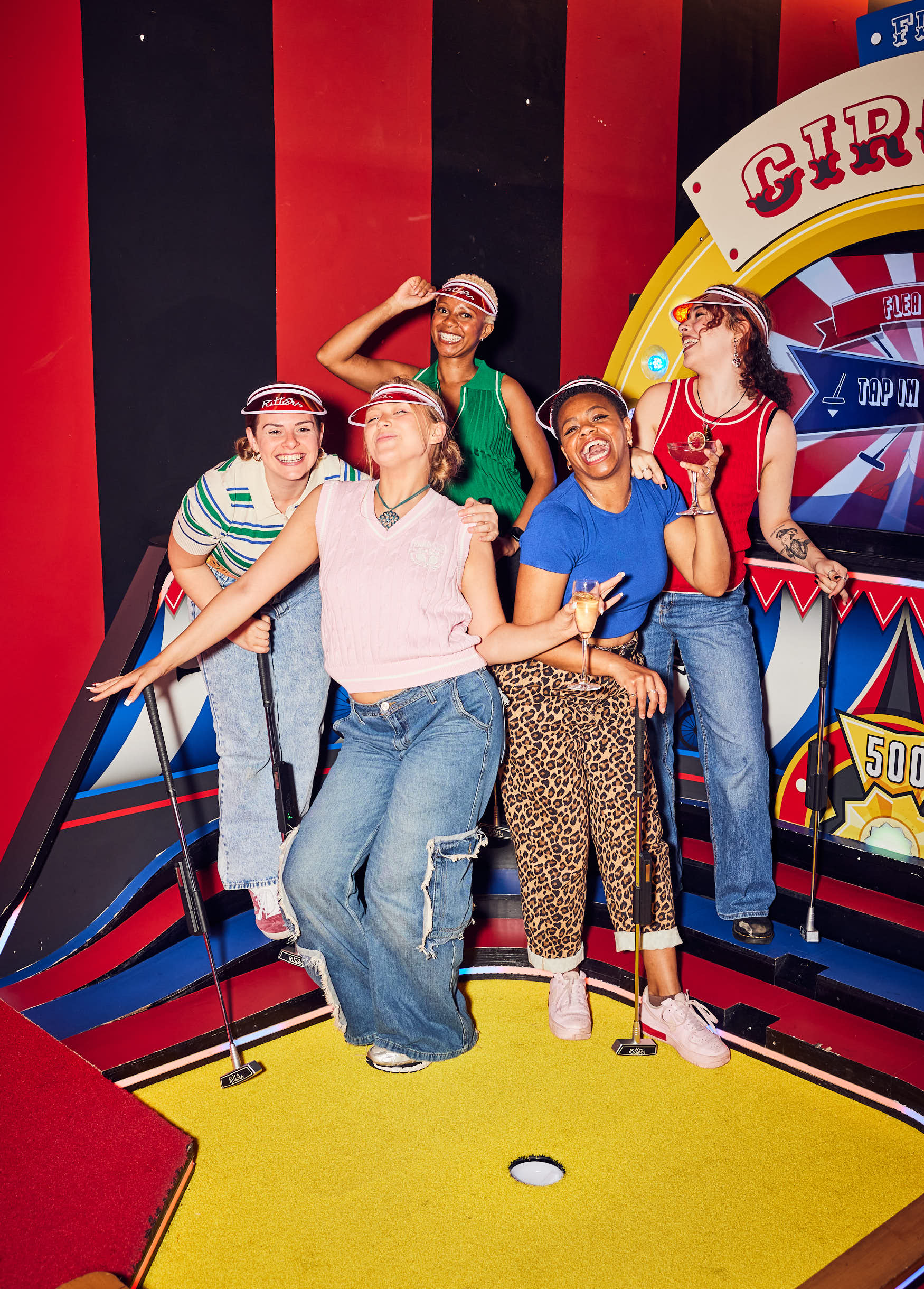
Putters, inside Urban Playground Manchester at the Arndale, takes that formula further. Three tech-infused themed nine-hole courses change how the game actually functions. Each hole has its own challenge, scoring is tracked automatically on a live daily leaderboard, and players are given three Double Points tokens to deploy strategically across the round. That mechanic forces a real decision each time about whether to bet on a tricky hole or save it for later, and the strategic layer keeps the competition feeling alive in a way standard crazy golf in Manchester rarely manages.
Where THE CUBE comes in
Urban Playground Manchester also has THE CUBE in the same space, and it operates on an entirely different register. Where Putters has a loose, social pace, THE CUBE has intensity. Groups of four step into the iconic glass box from the hit TV show, splitting into two teams of two, and take on a series of seven short, timed challenges testing balance, speed, memory, judgement and nerve. Every challenge plays out in full view of the rest of the group watching from outside the glass.
Challenges that look straightforward from the outside have a way of completely falling apart under the pressure of the countdown. That gap between expectation and reality is where most of the best moments come from, the ones that get talked about long after the session ends.
Together, Putters and THE CUBE give a group night out in Manchester something rare: genuine variety without having to move venues. The golf has a drifting, social energy. THE CUBE has focus and edge. One into the other tends to feel like a full evening rather than a single activity that's run its course.
Both are built around the same insight: the best things to do in Manchester on a night out aren't the most elaborate. They're the ones where the activity does enough work that the group can stop performing and start actually having fun.
Competitive socialising works. Urban Playground Manchester happens to be one of the better places in the city to let it.

Team Building in Manchester: Why Crazy Golf Beats the Workshop
Here's a thing that happens in offices. Someone books a team building day in Manchester. There's a facilitator. There are activities designed to help everyone communicate better, trust each other more, and leave feeling like a proper unit. There are probably sticky notes. By Friday, most people have forgotten it happened.
Nobody is trying to waste anyone's time. The intention is genuinely good. Teams do work better when they actually know each other, and getting a group of people out of their usual routine to spend a day together is a perfectly reasonable idea. The problem isn't the goal. It's the format.
You can't schedule the moment where people actually connect. It doesn't happen in a breakout exercise. It happens when something real occurs and people react to it: when the guard comes down, when someone surprises themselves, when the version of a colleague you've been dealing with in meetings briefly becomes the actual person.
That's much harder to manufacture than it sounds. But it's surprisingly easy to stumble into, given the right evening.
Why competitive activities work for team building
When a group of people play something competitive together, even something completely low-stakes, things happen that don't happen anywhere else. You see how people make decisions under mild pressure. You see how they handle being behind on a leaderboard. You see who thrives when everyone's watching and who quietly falls apart. None of this requires a debrief. It just happens, because the format produces it.
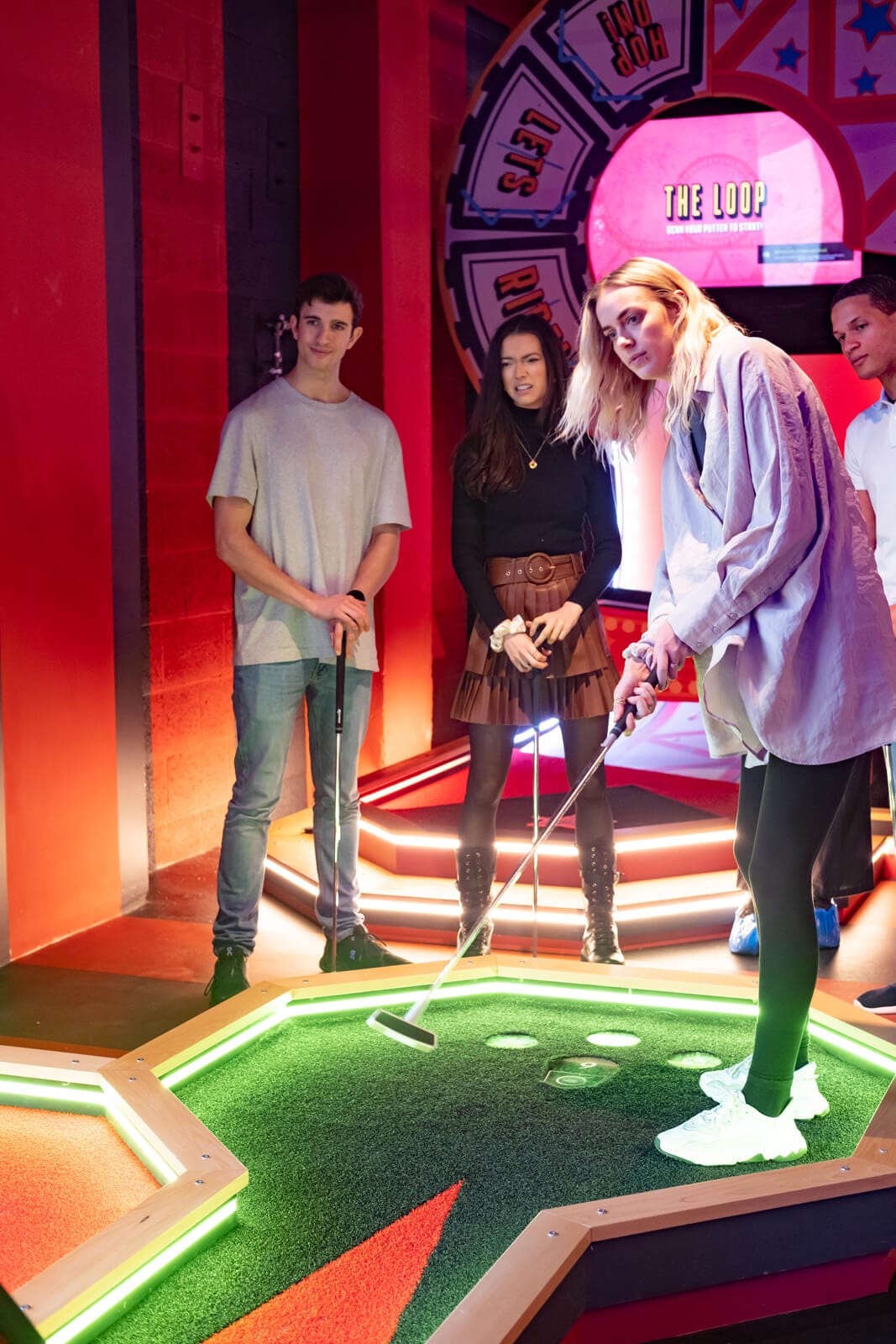
Crazy golf at Putters Manchester does this particularly well, and the reason is the Double Points mechanic. Across the round, each player gets three Double Points tokens to use however they like. On any hole, you can play safe and take the points you've earned, or back yourself on a harder shot and double whatever you score. It sounds like a small thing. It isn't. That decision, repeated strategically across nine, eighteen or twenty-seven holes, tells you a huge amount about the people you're playing with. Who takes risks without thinking twice. Who calculates carefully. Who saves their tokens for late in the round and then bottles it at the last second. You learn more about your colleagues from watching that decision play out than you do from a full morning of structured activities.
What the leaderboard does
Putters tracks everyone's score automatically and posts it on a live daily leaderboard, not just within your group, but against every other group who's played that day. This is what makes it genuinely competitive socialising rather than just a bit of fun. Your team isn't just playing each other. They're playing the whole day.
That shared external target does something interesting to a group. People get genuinely invested in the team score in a way that doesn't happen when the competition is purely internal. People who are professionally quite reserved start visibly caring. The leaderboard creates a shared mission without anyone having to announce there's a shared mission, which is the only way shared missions actually work.
The conversation afterwards
One of the underrated things about a good work night out in Manchester is what it does to the bar afterwards. After most corporate events, the conversation is polite. After a couple of hours at Putters, it's immediate and specific: who was unexpectedly brilliant, who made the worst Double Points call of the night, who held their nerve on the last hole and who completely didn't. People are talking about each other as people, not as colleagues, and that gap between the two is where the good stuff lives.
It doesn't require a debrief. It doesn't need facilitation. The evening creates the material and the bar takes care of the rest.
The practical bit
Putters sits inside Urban Playground at the Manchester Arndale: three tech-infused themed nine-hole courses, automated scoring, a daily leaderboard, fully stocked bars and food from THE BUTCHER. It works for teams of pretty much any size (groups of up to six per course at a time), it's in the city centre so getting there is easy, and the whole thing is already structured so nobody has to organise anything beyond booking.
If you're planning a work night out in Manchester and want one people are still talking about next week, skip the workshop. Book the golf.

Work Social Ideas in Manchester That Don't Feel Like Team Building
The moment someone uses the phrase "team building" in a work context, something happens to a room. Shoulders drop. Eyes glaze. Someone checks their phone under the table. It doesn't matter what the actual activity is, the label has already done the damage. Team building activity means organised fun, which is the least fun category of fun ever invented. It means a facilitator with a lanyard. It means being asked to trust-fall into someone from accounts. It means an afternoon you could have spent doing literally anything else.
The irony is that teams do actually bond. Just never during the thing that's been scheduled for the purpose.
They bond in the car on the way back. They bond at the bar afterwards. They bond during the fifteen minutes of chaos before the team quiz starts, or across a bowling lane, or while watching a colleague completely lose their composure on the fifth hole of a crazy golf course because they've just missed a shot a seven-year-old would have made blindfolded.
That's the moment. Not the icebreaker. Not the values workshop. The moment.
Why competitive activities do what corporate events can't
There's a reason competitive socialising in Manchester has replaced the work dinner as the default group night out for most teams. It's not because people are bored of restaurants. It's because a restaurant asks everyone to perform: to be witty, to make conversation, to be a slightly elevated version of themselves for two hours under fluorescent lighting and the pressure of a shared bill.
A competitive activity removes the performance. When there's a leaderboard involved, people stop trying to seem relaxed and actually become it. The focus shifts from the social anxiety of making a good impression to the immediate, practical problem of whether to use one of your Double Points on a hole that looks straightforward but almost certainly isn't.
That shift is the whole thing. It's where the actual human moments come from: the instinctive reactions, the genuine competitiveness nobody knew was there, the completely disproportionate celebrations and even more disproportionate complaints. You learn more about the people you work with in a couple of hours of something competitive than you do in a year of Monday morning stand-ups.
Where Putters fits into this
Putters Manchester, inside Urban Playground at the Arndale, is the version of crazy golf that leans fully into the competitive element rather than treating it as incidental. Three tech-infused themed nine-hole courses, automated scoring, and a live daily leaderboard that puts your group's score in the context of every other group who's played that day. Then there's the Double Points mechanic: each player gets three to deploy across the round, and you can bet your score on a harder route or a difficult shot whenever you decide the moment is right. Take it, or play safe. Either way, someone in the group has an opinion about which call you should make.
That decision, repeated across nine, eighteen or twenty-seven holes, is where group dynamics actually reveal themselves. Who's the risk-taker. Who calculates before they commit. Who burns their three Double Points in the first ten minutes. Who saves them all and never quite finds the right moment to use them. None of this is trivial. It's the kind of thing that builds the shorthand that makes a team actually function.
The leaderboard does something a facilitator never could: it creates genuine stakes without any of the manufactured intensity of a corporate exercise. Nobody's performing vulnerability. Nobody's sharing their communication style. They're just trying to beat the group of strangers who played before lunch and are currently sitting three points clear at the top of the daily board.
The practical case for not calling it team building
Work nights out in Manchester work better when the format does the work. The problem with most corporate events is that they put the whole weight of the evening on the group itself. A bar requires everyone to generate their own energy. A restaurant requires everyone to be interesting for two hours. An escape room requires a specific kind of group chemistry that either exists or doesn't.
Crazy golf at Putters Manchester requires none of that. The format is already structured. The competition is already present. The moments are already built in. The only thing the group has to do is show up, and the evening takes care of the rest.
This is why it works as a group activity in Manchester for teams of any makeup. Competitive enough that people get genuinely invested, low-stakes enough that nobody goes home in a bad mood, social enough that the bar and food around it extend the night naturally without anyone having to manufacture a reason to stay.
Call it a work night out. Call it a social. Call it whatever makes the calendar invite feel least threatening. Just don't call it team building.
The leaderboard will handle the rest.